Embroidery Hoop

Embroidery Hooping for Beginners

Embroidery Hooping for Beginners
Experience note This guide is written from a practical embroidery production viewpoint. In real embroidery work, hooping problems usually show up as puckering, outline misalignment, fabric shifting, uneven lettering, or thread trims between small separated objects. The advice below focuses on preventing those issues before you press start.

Introduction

Machine embroidery becomes much easier when you understand one basic rule: the design can only stitch as cleanly as the fabric is held. You may choose the right design, thread color, needle, and machine settings, but poor hooping can still make the final result look crooked, puckered, or uneven. That is why embroidery hooping for beginners is such an important skill. Hooping keeps the fabric and stabilizer secure while the needle moves thousands of times through the same area. If the fabric shifts even slightly, outlines may not meet, letters may look rough, and filled areas may pull the fabric inward. The good news is that hooping is not difficult once you know what to check. This guide explains the most common hooping mistakes, how to avoid them, which stabilizer to use, and how to troubleshoot problems before wasting fabric, thread, or customer garments.
Quick answer For most beginner projects, hoop the stabilizer and fabric together on a flat surface. Keep the fabric smooth and firm, not stretched. Use tear-away stabilizer for stable woven fabric, cut-away stabilizer for stretchy fabric, and water-soluble topping on towels or textured fabrics.
Embroidery Digitizing Services

If you are looking for embroidery digitizing services, EMDigitizer is one of the best embroidery digitizing companies. Providing all types of embroidery digitizing Services. I recommend you try digitizing services.

Order NowGet Free Quote

Why Hooping Matters in Machine Embroidery

Hooping is the foundation of machine embroidery. The hoop does more than hold the fabric; it controls how much the fabric can move while the design is stitched. A stable hoop setup helps your machine place stitches where the digitized file expects them to land.

When hooping is poor, the design may still run, but the results often reveal the problem after it is too late. You may see gaps between fill stitches and outlines, small letters that look messy, fabric that gathers around the design, or a finished embroidery that looks slightly tilted.

Good hooping improves registration, reduces puckering, protects fabric shape, and makes the finished embroidery look more professional. For paid embroidery jobs, it also reduces rework and customer complaints.

Basic Tools You Need Before Hooping
Basic Tools You Need Before Hooping

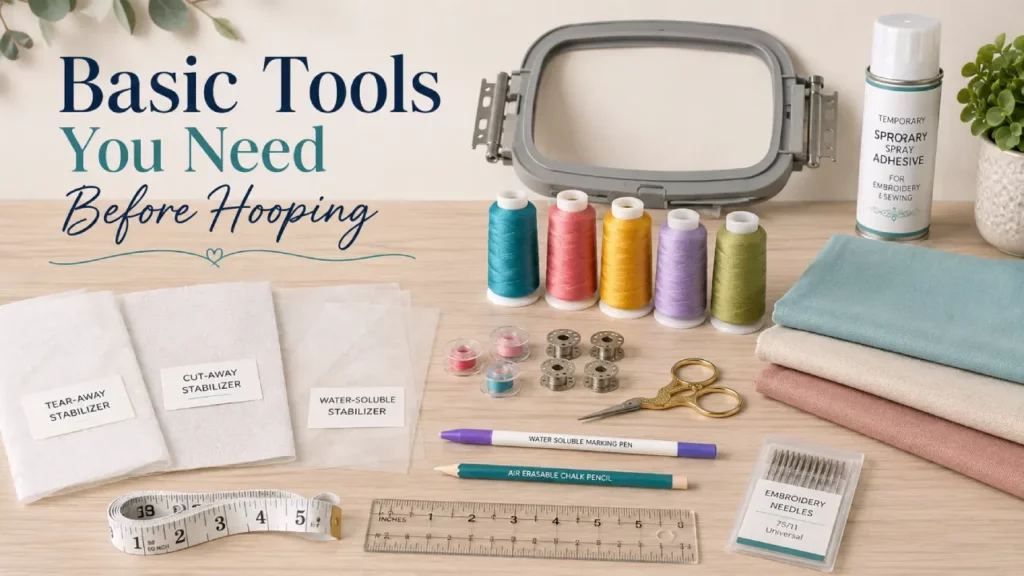
You do not need many tools to hoop correctly, but using the right materials makes the process easier.

  • Embroidery hoop that fits your machine and design size.
  • Fabric or garment pressed flat, with seams and folds moved away from the stitch area.
  • Correct stabilizer for the fabric and design density.
  • Fabric-safe marking tool, tailor chalk, placement sticker, or embroidery template.
  • Temporary adhesive spray or basting stitch for hard-to-hoop items, used carefully.
  • Embroidery needle suitable for the fabric type and thread.
  • Scrap fabric for test stitching when the material or design is new.

12 Common Embroidery Hooping Mistakes and How to Avoid Them
12 Common Embroidery Hooping Mistakes and How to Avoid Them

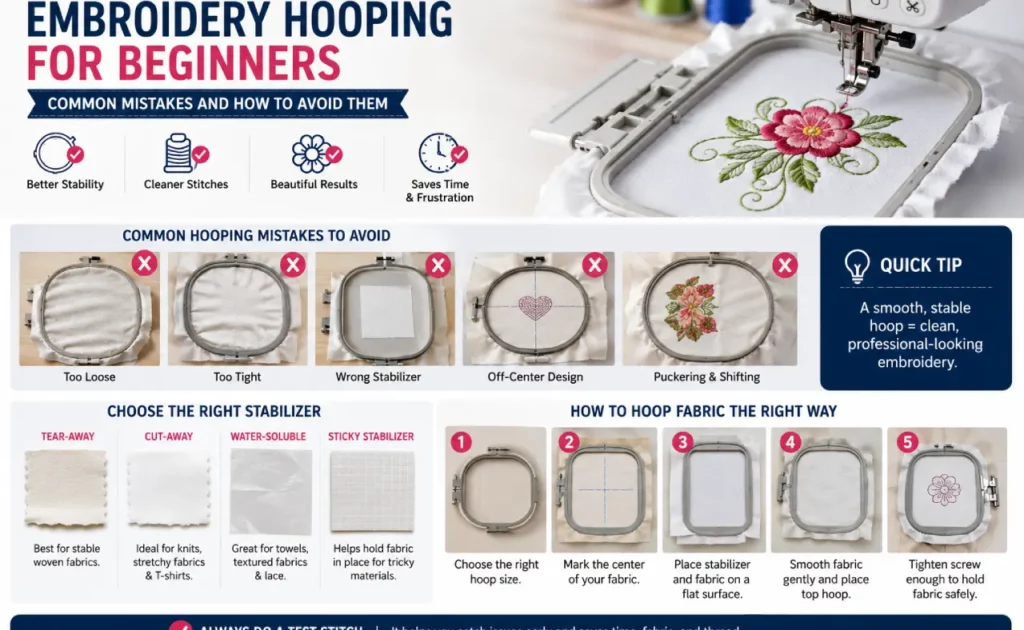
Mistake 1: Hooping the fabric too loose

Loose fabric is one of the most common beginner mistakes. If the fabric sags, wiggles, or lifts when you touch it, the stitches cannot land accurately. Loose hooping can cause puckering, registration gaps, uneven lettering, and fabric bunching under the needle. The fabric should feel smooth and firm. A light tap should feel snug, not floppy.

Mistake 2: Pulling the fabric too tight

Beginners sometimes pull the fabric hard after hooping because they think tighter is always better. This can stretch the fibers. When the hoop is removed, the fabric relaxes and the embroidery may pucker or warp. Smooth the fabric before inserting the inner hoop, then let the hoop hold it. Do not force the fabric into a stretched position.

Mistake 3: Using the wrong stabilizer

Stabilizer supports the fabric during stitching. Stable cotton, stretchy T-shirts, towels, fleece, denim, and sheer fabric do not all need the same support. A good design can still sew poorly if the stabilizer is too weak, too stiff, or wrong for the fabric. Match stabilizer to the fabric stretch, fabric weight, and stitch density.

Mistake 4: Using a hoop that is much larger than the design

A large hoop may seem convenient, but it gives the fabric more open space to flex and move. Use the smallest hoop that comfortably fits the design with safe clearance around the stitch area. Do not force a design into a hoop that is too small, but avoid oversized hoops for small logos.

Mistake 5: Not marking the center and direction

A design can be technically centered in the hoop and still look wrong on the garment. Mark the center, vertical direction, and top of the design area. This is especially important for shirts, towels, bags, aprons, pillow covers, and left chest logos.

Mistake 6: Hooping over seams, zippers, buttons, or thick edges

Hard seams and bulky areas stop the hoop from holding the fabric evenly. They can also cause the hoop to pop out or the machine foot to hit an obstruction. Move the design away from bulky construction areas or use a floating method when the item cannot be hooped flat.

Mistake 7: Ignoring fabric stretch and nap

Knits stretch, towels have loops, fleece has pile, and velvet or corduroy has nap. These surfaces behave differently under the needle. Stretchy fabrics usually need cut-away support. Textured fabrics often need a water-soluble topping so stitches do not sink into the surface.

Mistake 8: Tightening the hoop screw after the fabric is inside

Adjust the hoop before inserting the fabric. If you tighten the screw too much after the fabric is already hooped, you may create uneven tension. A better method is to pre-adjust the hoop, press the inner hoop into place, and make only a small final adjustment if needed.

Mistake 9: Letting extra fabric fall into the stitch area

Shirts, bags, and towels often hide extra fabric under the hoop. Before stitching, check the underside and around the hoop. Keep sleeves, bag pockets, towel corners, and garment layers away from the needle path.

Mistake 10: Skipping a test stitch

A test stitch is the safest way to confirm stabilizer, hooping, needle, density, and thread tension. This matters most for customer garments, dense logos, small lettering, stretchy fabric, towels, and expensive items. Testing on scrap fabric can save the final piece.

Mistake 11: Floating without enough hold

Floating means hooping the stabilizer first and placing the fabric on top. It is useful for thick or delicate items, but the fabric must still be secure. Use temporary adhesive, basting stitches, or careful pinning outside the stitch area. Never place pins where the needle can hit them.

Mistake 12: Blaming the digitized file before checking the hoop

Sometimes the file does need adjustment, especially if the design is too dense for the fabric. But many problems are hooping-related. Before redigitizing, check hoop tension, stabilizer, fabric stretch, design placement, and whether the hoop stayed locked during stitching.

Stabilizer Selection Guide for Beginners

The fabric usually determines the stabilizer type, while the design density determines how much support is needed. Use this table as a starting point, then test on scrap fabric when possible.

Fabric / Item

Best starting stabilizer

Hooping method

Expert tip

Stable woven cotton

Medium tear-away

Hoop fabric and stabilizer together

Good for beginner practice, napkins, patches, and simple craft projects.

T-shirts / jersey / knits

Medium cut-away

Hoop gently without stretching

Do not use only tear-away for stretchy fabric unless the design is very light.

Towels / terry cloth

Tear-away or cut-away under the fabric plus water-soluble topping

Hoop or float depending on thickness

Topping keeps stitches from sinking into towel loops.

Fleece / plush / textured fabric

Cut-away support plus water-soluble topping

Hoop carefully or float

Choose designs with bold shapes and avoid very tiny lettering.

Denim / canvas / tote bags

Tear-away or cut-away depending on design density

Hoop if flat, float if bulky

Use a strong needle and avoid thick seams.

Delicate or sheer fabric

Wash-away or lightweight cut-away depending on project

Test first; avoid hoop marks

Use lower density designs and consider floating if hoop pressure damages fabric.

Caps, collars, cuffs, bags

Item-specific backing or adhesive stabilizer

Usually floated or hooped with specialty frame

Secure the item well and confirm the needle path before stitching.

Expert tip
If the design has high stitch density, small satin letters, or heavy fills, the fabric needs more support. If the fabric stretches, the stabilizer must control that stretch. If the surface is fluffy or textured, add a topping so stitches remain visible.

How to Hoop Fabric the Right Way

How to Hoop Fabric the Right Way

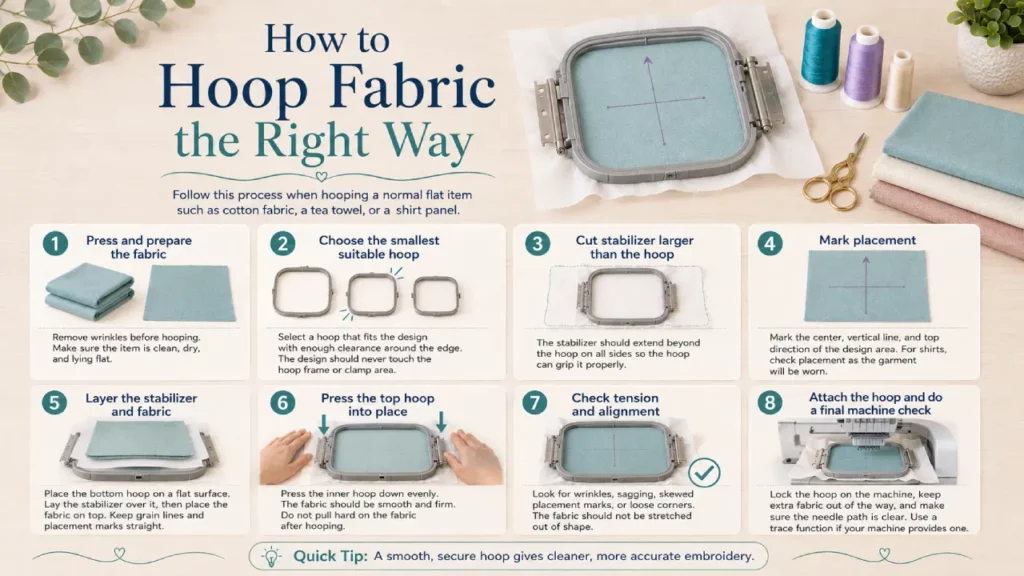
Follow this process when hooping a normal flat item such as cotton fabric, a tea towel, or a shirt panel.

Step 1: Press and prepare the fabric

Remove wrinkles before hooping. Wrinkles inside the hoop can become permanent stitch problems. Make sure the item is clean, dry, and lying flat.

Step 2: Choose the smallest suitable hoop

Select a hoop that fits the design with enough clearance around the edge. The design should never touch the hoop frame or clamp area.

Step 3: Cut stabilizer larger than the hoop

The stabilizer should extend beyond the hoop on all sides. If it is too small, the hoop cannot grip it properly.

Step 4: Mark placement

Mark the center, vertical line, and top direction of the design area. For shirts, check placement while considering how the garment will be worn, not only how it lies flat on the table.

Step 5: Layer the stabilizer and fabric

Place the bottom hoop on a flat surface. Lay the stabilizer over it, then place the fabric on top. Keep grain lines and placement marks straight.

Step 6: Press the top hoop into place

Press the inner hoop down evenly. The fabric should be smooth and firm. Do not pull hard on the fabric after hooping.

Step 7: Check tension and alignment

Look for wrinkles, sagging, skewed placement marks, or loose corners. The fabric should not be stretched out of shape.

Step 8: Attach the hoop and do a final machine check

Make sure the hoop is locked on the machine, extra fabric is out of the way, and the needle path is clear. Use a trace function if your machine provides one.

Hooping Troubleshooting: Symptoms, Causes, and Fixes

Problem after stitching

Likely cause

How to fix it next time

Puckering around the design

Fabric was too loose, too stretched, or under-stabilized.

Use the correct stabilizer, hoop firm but not stretched, and test with less dense designs on thin fabric.

Outline does not match the fill

Fabric shifted during stitching or stabilizer was not strong enough.

Use better hoop tension, stronger backing, and reduce movement by using a smaller hoop.

Small letters look rough

Letters are too small, fabric is unstable, or hooping shifted.

Use cut-away on soft/stretchy fabric, increase design size if possible, and test stitch small text.

Stitches sink into towels or fleece

No topping was used on textured fabric.

Add water-soluble topping over the fabric before stitching.

Hoop marks remain on fabric

Hoop pressure was too strong or fabric is delicate.

Use gentler hooping, float the item, or test hoop marks on hidden area first.

Fabric slips out of the hoop

Hoop was too loose, stabilizer too small, or item too thick.

Pre-adjust the hoop, cut stabilizer larger, and use floating for bulky items.

Thread breaks after hooping

Needle may hit a pin/seam, fabric is too tight, or design is too dense.

Keep pins out of the stitch path, avoid seams, and check needle/design density.

Special Tips for Tricky Fabrics

Towels

Towels have loops that can swallow stitches, especially small text and thin outlines. Use a topping on the surface and a suitable backing underneath. Avoid stretching the towel in the hoop. If the towel is thick, float it on hooped stabilizer and secure it with a basting stitch.

T-shirts and stretchy fabric

Use cut-away stabilizer because it stays behind the embroidery and continues supporting the stitches after the garment is worn and washed. Keep the shirt in its natural shape. If you stretch it in the hoop, the design may look wrinkled after you remove it.

Thick bags, collars, and cuffs

These items are often difficult to hoop because seams and hardware prevent even pressure. Float the item over hooped stabilizer, use a basting box if available, and keep clips, pins, handles, and extra fabric away from the needle path.

Thin or delicate fabric

Delicate fabric can show hoop marks or distortion. Test first. Use lighter designs, a suitable stabilizer, and gentle hooping. For sheer projects, consider wash-away stabilizer where no backing residue should remain.

Quick Checks Before You Press Start

  • Fabric is smooth, firm, and not stretched out of shape.
  • Stabilizer fully covers the design area and extends beyond the hoop.
  • Placement marks are centered and straight.
  • Hoop is attached properly to the machine.
  • Extra fabric, sleeves, pockets, towel corners, and bag layers are out of the way.
  • Needle path is clear of pins, seams, clips, and hardware.
  • Thread color sequence and bobbin are ready.
  • A test stitch has been done for new fabric, dense designs, or customer garments.

How to Build Confidence with Hooping

Practice on simple projects before moving to expensive garments. Beginner-friendly projects include napkins, tea towels, plain tote bags, pillow covers, and scrap fabric samples. Start with stable cotton and medium-weight designs before trying stretchy shirts or thick towels.

Keep a small hooping log. Write down the fabric, stabilizer, needle, design size, stitch count, and final result. Over time, these notes become your own embroidery reference library. This is one of the fastest ways to improve from beginner results to professional-looking embroidery.

Conclusion

Hooping is one of the most important skills in machine embroidery because it controls fabric stability, design placement, and stitch quality. Most beginner problems come from loose fabric, over-stretched fabric, poor stabilizer choice, oversized hoops, or hidden folds under the hoop.

Take your time before stitching. Prepare the fabric, choose the right stabilizer, mark the placement, hoop on a flat surface, and check everything before pressing start. With practice, hooping becomes a reliable process instead of a guessing game.

FAQ: Embroidery Hooping for Beginners

What does hooping mean in machine embroidery?

Hooping means placing fabric and stabilizer inside an embroidery hoop so they stay stable while the machine stitches the design.

How tight should fabric be in an embroidery hoop?

The fabric should be smooth and firm, but not stretched. It should not sag, wrinkle, or move inside the hoop.

Should embroidery fabric be drum-tight?

No. It should feel snug, but not stretched like a drum. Over-tight fabric can relax after hoop removal and create puckering.

Can I embroider without hooping the fabric?

Yes. Some items can be floated over hooped stabilizer. Floating is useful for thick, delicate, small, or hard-to-hoop items.

What stabilizer is best for beginners?

Tear-away is easy for stable woven cotton. Cut-away is usually better for T-shirts, knits, and stretchy fabric. Water-soluble topping is useful for towels and textured fabrics.

Why is my embroidery puckering?

Puckering can come from loose hooping, over-stretching, weak stabilizer, dense stitching, thin fabric, or wrong design settings for the fabric.

Why do my outlines not line up?

Outline misalignment usually means the fabric moved during stitching, the hoop was too loose, the stabilizer was not strong enough, or the design is too dense for the fabric.

Can I use tear-away stabilizer on T-shirts?

It is not the best first choice. T-shirts stretch, so cut-away stabilizer usually gives better long-term support.

How do I prevent hoop marks?

Use gentle hooping, avoid over-tightening, test first, and float delicate fabric if hoop pressure leaves marks.

Should I use adhesive spray?

Temporary adhesive can help with floating or difficult items, but use it carefully. Spray away from the embroidery machine and avoid heavy buildup on the needle area.

If you have any questions leave the comments or you can visit our social channels for more updates regularly. We provide embroidery digitizing services if you need digitizing services feel free to contact us or email us.